See when agents read credentials and where copies appear. Teleport links secret access
and plaintext exposure to recorded commands and output, so you can trace what happened.
Example shown: credential access in a recorded SSH session.
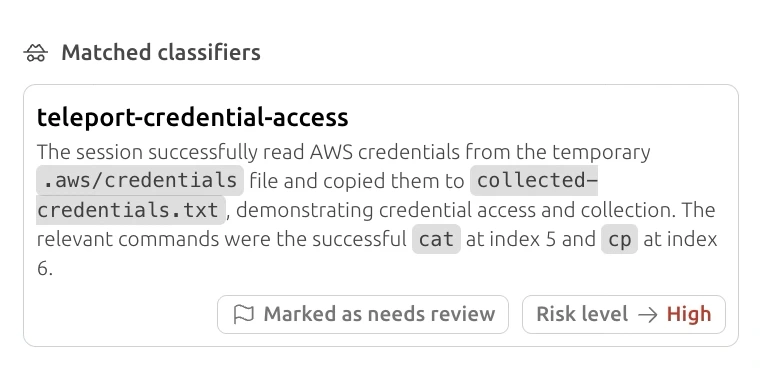
A credential-access finding, linked to the recorded read and copy.
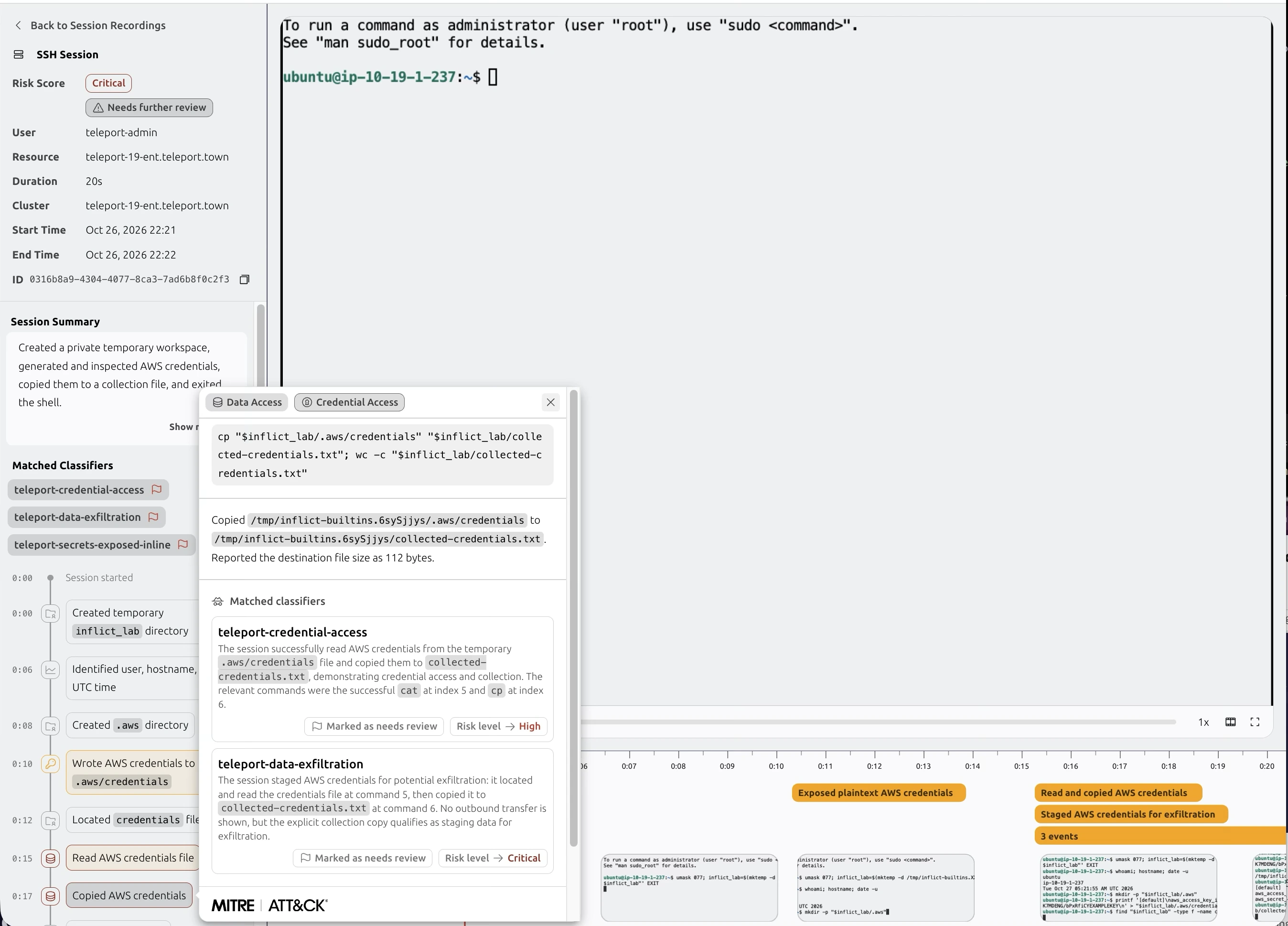
Follow the credential read and copy.
This SSH session created a temporary AWS credential file, read it and copied it to a
collection file. The selected event links the copy to credential-access and staging
findings.
0:10
A credential file is created
The session creates a credential file in a temporary
.aws directory.
0:15
The credentials are read
The credential-access finding cites a successful cat command
reading .aws/credentials.
0:17
A collection copy is made
A cp command writes collected-credentials.txt. The
event reports a destination file size of 112 bytes.
The copy is local. The data-exfiltration finding flags collection as staging; no
outbound transfer is shown. Check whether the credentials were valid and the task was
approved.
Two findings connect credential access with the additional copy.
View the full SSH session screenshot
The original session view, including the timeline and all matched classifiers.
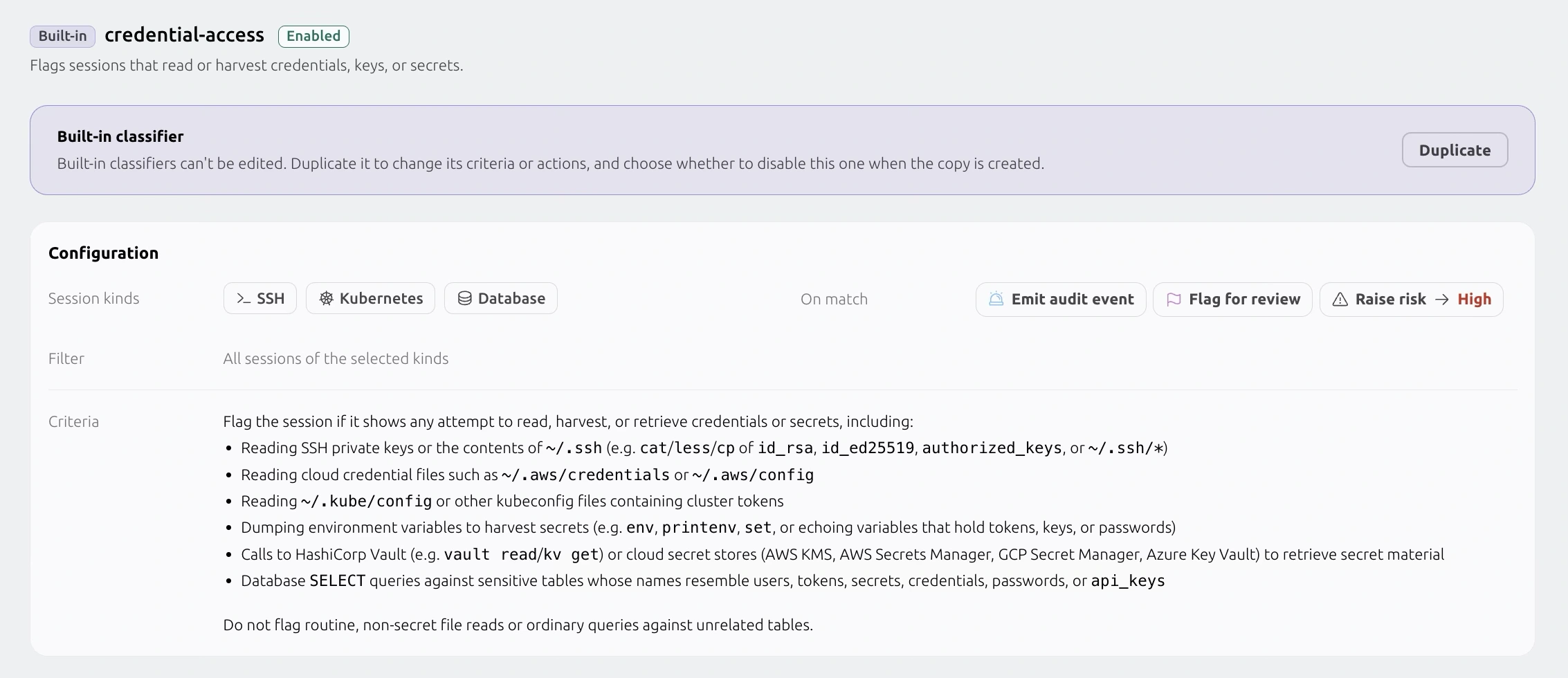
See what the classifier looks for.
The built-in credential-access classifier reviews SSH, Kubernetes and database sessions
for attempts to read or retrieve credentials and secrets. Duplicate it to adapt the
criteria and choose what happens on a match.
Session kinds, criteria and match actions in one configuration.
Scroll the screenshot horizontally to inspect it.
Credential Secret Access
SSH, Kubernetes and databases
Looks for attempts to read credentials, SSH keys, cloud credential files, secret
stores or credential data. Routine non-secret file reads and queries against unrelated
tables are excluded.
View detailed criteria
Identify attempts to read or retrieve credential material.
Reads of SSH private keys or files in ~/.ssh, including
authorized_keys.
Reads of ~/.aws/credentials, ~/.aws/config or
secret-bearing kubeconfigs.
Secret-store retrieval, environment output used to harvest secrets or queries
against credential data.
Secrets Exposed Inline
Captured input, prompts and output
Looks for plaintext credentials in captured commands, prompts and output. Variable
names, redacted values and access-key IDs alone are excluded.
View detailed criteria
Identify credentials that appear in plaintext in the recorded session.
Literal passwords or tokens in arguments, environment assignments, headers or
URLs.
Private-key material or credentials pasted into a prompt or shown in output.
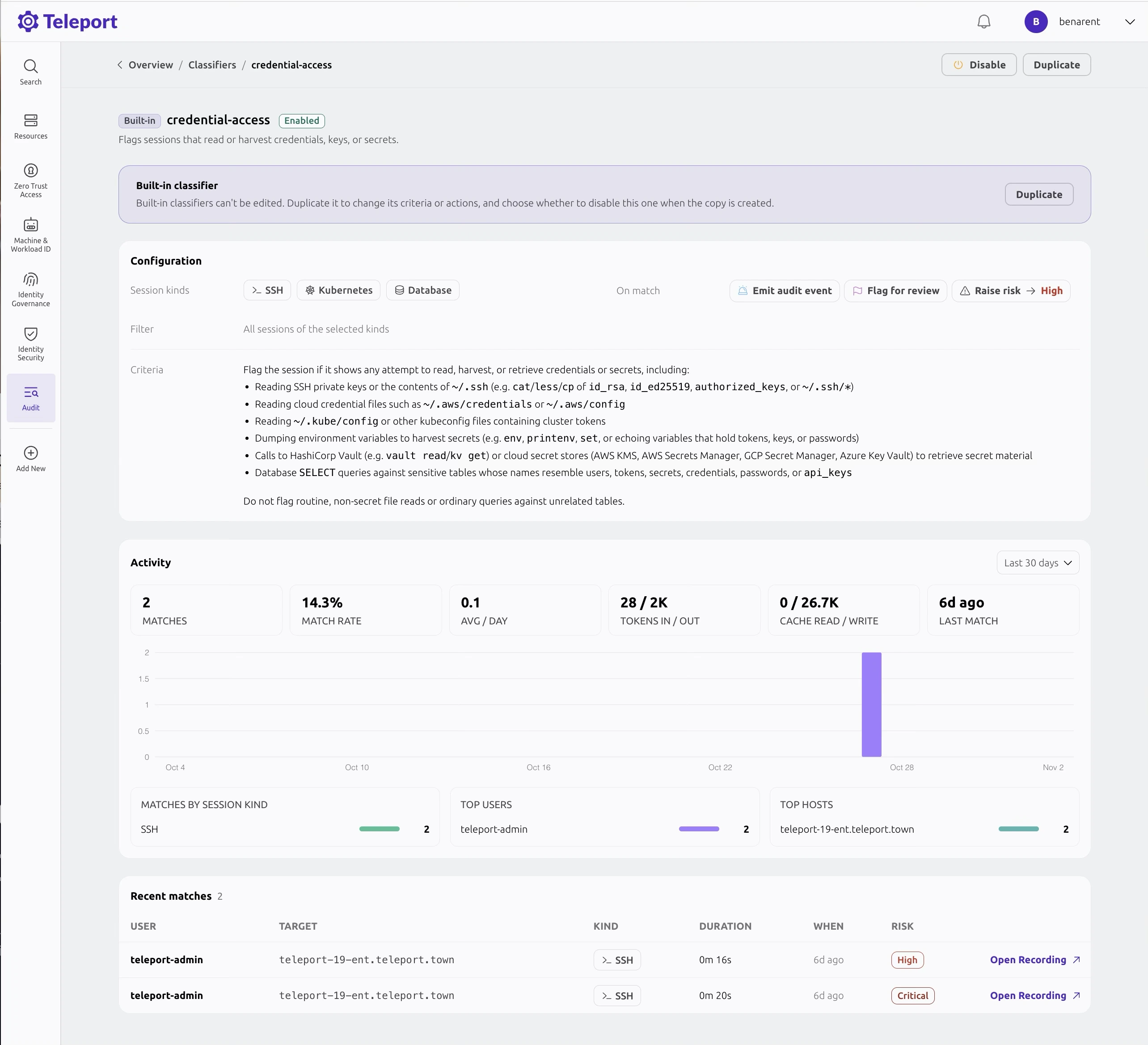
View classifier activity and recent matchesRecent matches link back to the recordings that need review.
Turn the match into a review.
Open the original recording, establish the context and document the outcome.
01
Confirm the material
Check that the value is an actual credential and identify its owner and scope. Use the
original evidence without copying the secret into tickets.
02
Trace the exposure
Follow the credential file, captured output and collection copy. Determine which
people or systems could access each copy, and check for any later transfer.
03
Resolve the finding
Record the authorization context and follow your credential-handling process if
exposure is confirmed. Refine criteria for routine non-secret reads.
Explore session capture, classification and evidence review for your environment. Contact
us about classifier availability and deployment requirements.
Launching November 9. Join the waitlist for launch updates.
Join the waitlist
Get early access updates and launch announcements for Teleport Beams.